


How does the automation level of a CNC shearing machine compare with that of a standard shearing machine?
The CNC shearing machine offers a significantly higher level of automation than a standard shearing machine. Through computerized controls, automated backgauge positioning, programmable cutting sequences, and digital job storage, a CNC shearing machine minimizes manual intervention and delivers more consistent production results. In contrast, a standard shearing machine relies heavily on operator experience for setup, positioning, and dimensional adjustments.
For manufacturers processing large volumes of sheet metal, the difference in automation can directly impact productivity, labor costs, material utilization, and product quality. While a standard machine may be suitable for simple or low-volume applications, a CNC shearing machine is generally the preferred solution when efficiency and repeatability are critical.
In many fabrication environments, CNC-controlled equipment can reduce setup times by more than 50%, improve dimensional accuracy, and support continuous production with fewer operator adjustments. These advantages make CNC technology increasingly common in modern sheet metal processing facilities.
Understanding Automation in Sheet Metal Shearing
Automation refers to the ability of a machine to perform operational tasks with minimal human involvement. In sheet metal shearing, automation includes functions such as material positioning, backgauge movement, cutting parameter adjustment, job storage, production sequencing, and process monitoring.
A standard shearing machine typically requires operators to manually set cutting dimensions, adjust stops, verify measurements, and monitor each production run. Every new job often involves repeating setup procedures from the beginning.
By comparison, a CNC shearing machine automates many of these tasks. Once production parameters are entered into the control system, the machine can execute repetitive cutting operations with exceptional consistency. This reduces operator workload while increasing production efficiency.
Major Automation Features Found in a CNC Shearing Machine
Automatic Backgauge Positioning
The backgauge controls the length of material being cut. In a standard shearing machine, operators often reposition the backgauge manually. A CNC shearing machine automatically moves the backgauge according to programmed dimensions, often achieving positioning accuracy within fractions of a millimeter.
Digital Program Storage
Modern CNC controllers allow operators to save production programs. If the same component is required months later, the program can be recalled instantly without repeating setup calculations.
Automatic Production Sequencing
A CNC system can execute multiple cutting dimensions in sequence. This capability is particularly valuable when producing parts with varying lengths during the same production cycle.
Integrated Monitoring Functions
Many CNC systems include diagnostic capabilities that monitor operating conditions, detect errors, and help maintenance teams identify issues before they cause significant downtime.
Automation Comparison Table
| Automation Feature | CNC Shearing Machine | Standard Shearing Machine |
|---|---|---|
| Backgauge Adjustment | Automatic | Manual |
| Job Storage | Available | Not Available |
| Repeatability | Very High | Operator Dependent |
| Setup Time | Low | High |
| Production Flexibility | High | Moderate |
| Operator Skill Requirement | Lower During Production | Higher |
Impact on Production Efficiency
One of the most measurable benefits of automation is improved production efficiency. Because a CNC shearing machine can automatically position materials and execute programmed cuts, operators spend less time making adjustments between jobs.
For example, a fabrication shop producing hundreds of identical sheet metal panels may reduce setup time from 30 minutes on a standard machine to less than 10 minutes on a CNC machine. Over multiple production runs, these time savings become substantial.
Many manufacturers report productivity improvements ranging from 20% to 60% after upgrading from manual systems to CNC-controlled equipment. The exact improvement depends on production volume, part complexity, and operator experience.
Accuracy and Repeatability Advantages
Automation directly influences cutting accuracy. Manual measurements introduce opportunities for human error, especially during long production shifts. Even experienced operators may encounter slight variations when repeatedly adjusting dimensions.
A CNC shearing machine uses programmed positioning systems that repeatedly move to the same coordinates. As a result, dimensional consistency remains stable throughout large production batches.
This advantage is especially important when producing components for industries where dimensional tolerances must remain consistent from part to part. Reduced variation also lowers scrap rates and improves overall material utilization.
Labor Efficiency and Workforce Requirements
Automation can significantly reduce labor demands. Standard shearing machines often require continuous operator involvement during setup and production. Operators must frequently verify dimensions and adjust machine settings.
With a CNC shearing machine, many routine tasks are performed automatically. Operators primarily focus on loading materials, monitoring production, and performing quality checks. This allows one operator to oversee more production activities simultaneously.
- Reduced setup labor
- Less operator fatigue
- Improved production consistency
- Lower risk of measurement errors
- Greater productivity per employee
How a Hydraulic Guillotine Shearing Machine Fits Into the Comparison
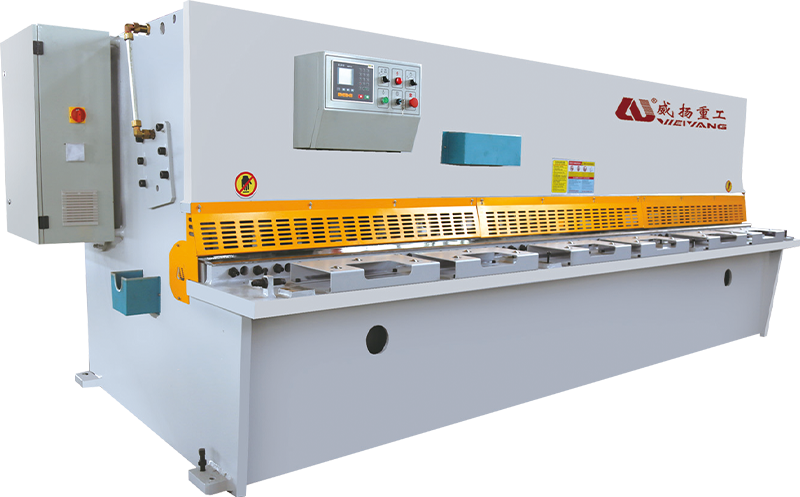
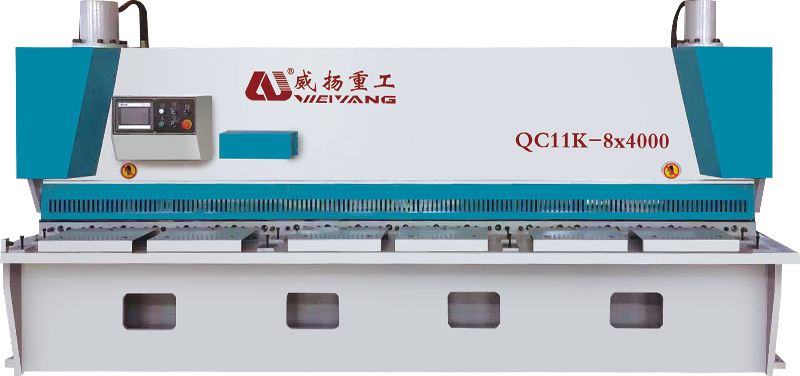
Many modern fabrication facilities utilize a hydraulic guillotine shearing machine because of its ability to deliver powerful and accurate cuts across a wide range of material thicknesses. When combined with CNC controls, a hydraulic guillotine shearing machine achieves both high cutting performance and advanced automation.
A CNC-controlled hydraulic guillotine shearing machine can automatically manage backgauge movement, cutting length settings, and production programs. This combination offers substantial advantages over manually operated equipment, especially in high-volume manufacturing environments.
For manufacturers processing thick steel plates, stainless steel sheets, or large-format metal panels, a hydraulic guillotine shearing machine equipped with CNC technology often provides the ideal balance between power, precision, and automation.
When a Standard Shearing Machine May Still Be Suitable
Despite the advantages of CNC automation, standard shearing machines still serve specific applications effectively. Small workshops with limited production requirements may not need advanced programming capabilities.
A standard machine may be appropriate when:
- Production volumes are low.
- Part dimensions change infrequently.
- Budget constraints are significant.
- Operators possess extensive manual setup experience.
However, as production demands increase, the limitations of manual operation become more apparent, often making automation a worthwhile investment.
Final Comparison and Recommendation
The automation level of a CNC shearing machine is substantially higher than that of a standard shearing machine. Features such as automatic backgauge control, digital job storage, programmable cutting sequences, and integrated diagnostics enable manufacturers to achieve greater productivity and more consistent quality.
For companies focused on efficiency, repeatability, reduced labor costs, and large-scale production, a CNC shearing machine is generally the superior solution. When paired with a hydraulic guillotine shearing machine design, CNC automation becomes even more valuable by combining powerful cutting capability with advanced production control.
While standard shearing machines remain useful for basic cutting operations and smaller workshops, the long-term advantages of CNC automation make it the preferred choice for most modern metal fabrication environments.
Related Product
-
 +86-13813747229
-
 [email protected]
-
 No. 22 Haifang Avenue, Chengdong Town, Hai'an City, Jiangsu Province,China.
Copyright © 2024Jiangsu Weiyang Heavy Industry Technology Co., Ltd. All Rights Reserved.
Custom Hydraulic Power CNC Press Brake Machines Manufacturers
