


Electric Hydraulic Shearing Machine Guide: Specs, Types & Buying Tips | VYMT
Sheet-Metal Cutting · Buyer's Field Guide
The Cut That Sets the Standard: Inside the Electric Hydraulic Shearing Machine
Hydraulic force decides whether the machine can cut; electrical control decides whether every cut lands in the same place. Here is how to buy the first without giving up the second.
Ask a press brake operator where most bending problems begin, and the answer is rarely the press brake. It is the blank. A 6 mm stainless panel sheared with the wrong blade clearance comes off the machine with a burr, a faint twist and a ragged fracture line — and no amount of downstream fixturing will fully hide it.
The short version first: an electric hydraulic shearing machine is the default choice for straight-line cutting of sheet and plate roughly 1 mm to 25 mm thick, because it pairs hydraulic force with electronically controlled precision. If your shop cuts panels, brackets, enclosures or cladding to length in batches, this is the machine class to shortlist. What follows covers what the name actually means, how a cut cycle unfolds, where swing beam and gate designs differ, and which specifications deserve a hard look before money changes hands.
What "Electric Hydraulic" Actually Describes
The name describes the drive logic, not a marketing flourish. An electric motor spins a hydraulic pump; proportional or servo valves, governed by electronics, meter pressurized oil to two cylinders that drive the upper blade beam. Hydraulics supply the force. Electrics supply the control.
That split explains why the design displaced all-mechanical shears in most workshops. A mechanical machine stores energy in a flywheel and releases it through a clutch: fast, but with a fixed stroke, shock loading and almost no adjustment. An electro-hydraulic machine lets the controller set stroke length, cutting speed and blade gap, then delivers full force smoothly and relieves overload on its own.
Around that drive logic, a typical machine includes:
- A stress-relieved welded frame with machined blade seats
- An upper blade beam, or ram, carrying one long blade
- A fixed lower blade set at a calculated clearance
- Two hydraulic cylinders synchronized by a torsion bar or by electronic control
- Hydraulic hold-downs that clamp the sheet ahead of the cut line
- A motorized backgauge on ball screws for repeat positioning
- A squaring arm plus front support arms for long sheets
- An NC or CNC controller managing gauge position, stroke length and, on many models, shear angle
Info: Blade clearance is the setting that separates a clean edge from scrap. A common starting point is roughly 5–10% of sheet thickness for mild steel — slightly tighter for soft aluminum, slightly wider for stainless and heavy plate — always confirmed against the manufacturer's chart.
The Cutting Cycle, Step by Step
Every stroke follows the same disciplined sequence. The controller positions the backgauge; the sheet is brought against it. Hold-downs clamp the material so nothing shifts under cutting force. The ram approaches quickly, then transitions to working speed as the blade meets the edge. Cutting proceeds along a slight rake angle — typically between about 0.5° and 2.5° — so the blade engages progressively instead of fighting the full sheet length at once. The return stroke lifts the blade, hold-downs release, and the backgauge repositions for the next piece.
±0.1 mm
Typical repeat positioning accuracy of a servo-driven backgauge on a well-built electro-hydraulic shear.
Two details matter to buyers. The start and end of every cut show a slightly rounded or ragged zone; that is normal physics, not a defect. And the clearance between upper and lower blades directly sets burr height: too tight and edges wear fast, too wide and the sheet drags and rolls into the gap. For the valve-and-cylinder sequence in more depth, this walkthrough of the working steps of a CNC shearing machine's hydraulic system follows the oil flow stroke by stroke.
A shear does not make the part. It decides whether the part is possible — every bend, weld seam and finished panel starts from the edge the shear leaves behind.
Swing Beam or Gate? The Choice That Shapes Everything
For thin-to-medium sheet and general batch work, a swing beam machine wins on simplicity and purchase price. For long sheets, thick plate, tight straightness requirements or continuous production, a gate machine — often called a guillotine — earns its premium. Almost every other decision hangs on this fork.
A swing beam ram pivots through an arc around a fixed point: the rake angle stays constant along the cut, blades carry four usable edges, and the mechanism is compact and forgiving to set up. A gate machine's ram travels straight down between machined guides, supports the cut over the full length, and on most models allows an adjustable shear angle — the lever that reduces twist and camber on long, narrow blanks.
| Aspect | Swing Beam | Gate (Guillotine) |
|---|---|---|
| Ram motion | Arc around a fixed pivot | Straight down along machined guides |
| Sweet spot | Thin-to-medium sheet, general batch work | Medium-to-thick plate, long sheets, heavy duty cycles |
| Blade setup | Constant rake angle; four usable edges per set | Full-length support; shear angle often adjustable |
| Long narrow blanks | Arc path can add slight twist on very long strips | Straighter edges, less camber and twist |
| Acquisition cost | Lower | Higher |
Both designs sit in Weiyang's standard range, so it is worth comparing them side by side before committing:
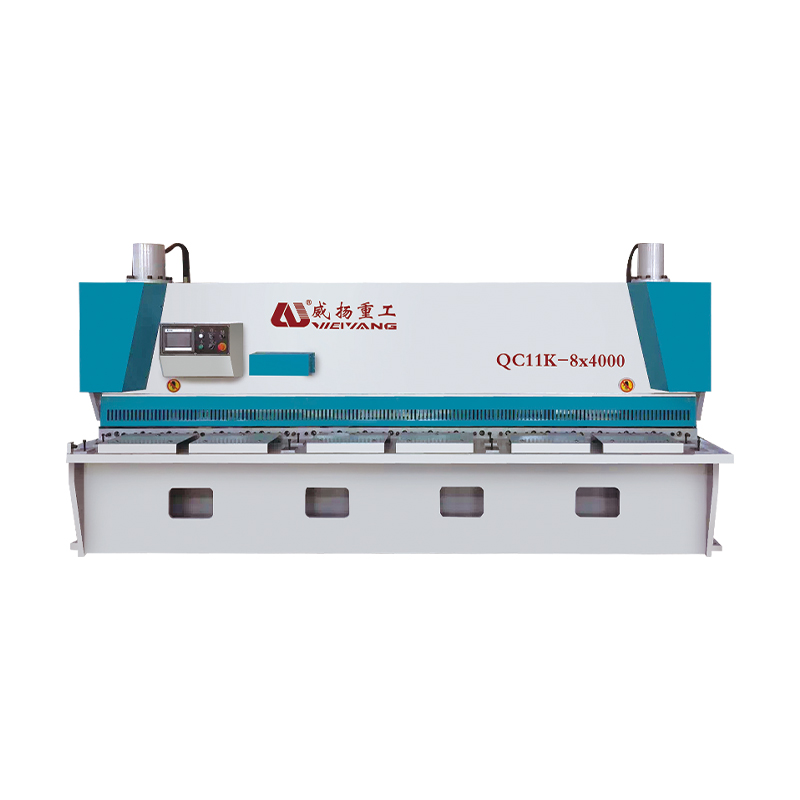 Gate shearing machineSwing shearing machine Read MoreView Product →
 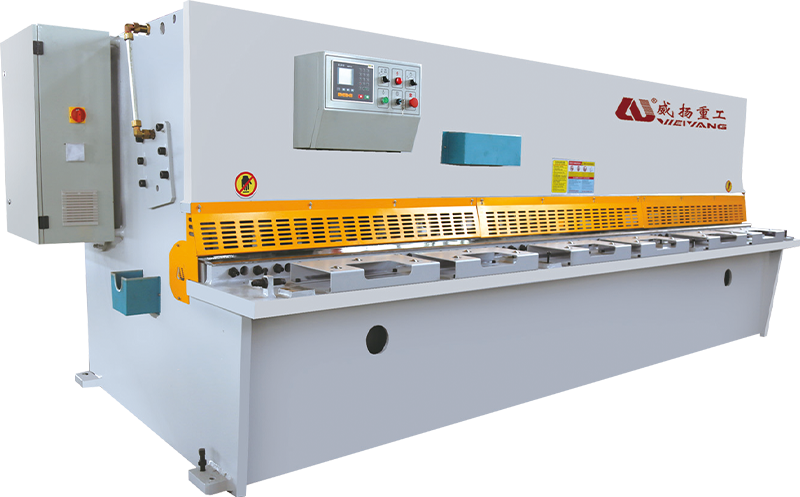 Swing shearing machineSwing shears are usually used for shearing plates underneath 10mm. They may be prepared with non-obligatory CNC structures, front servo feeding structures, rear pneuma...View Product →
Where the Machine Earns Its Keep
The application list reads like a map of metal fabrication. Panel and bracket blanks headed for a press brake. Enclosures and electrical cabinets in galvanized or cold-rolled sheet. Stainless cladding and decorative products, where edge finish is part of the product itself. Metallurgical workshops trimming plate to size. Aviation sheet-metal shops cutting aluminum skins and doublers, where edge quality feeds directly into forming.
Weiyang's project references — its aviation industry work among them — follow exactly that pattern: the shear at the front of the line, forming and joining behind it.
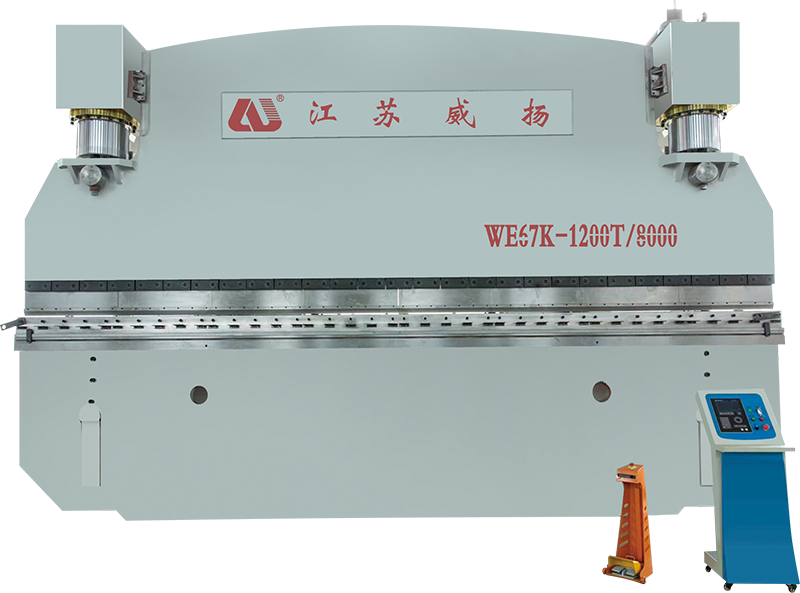
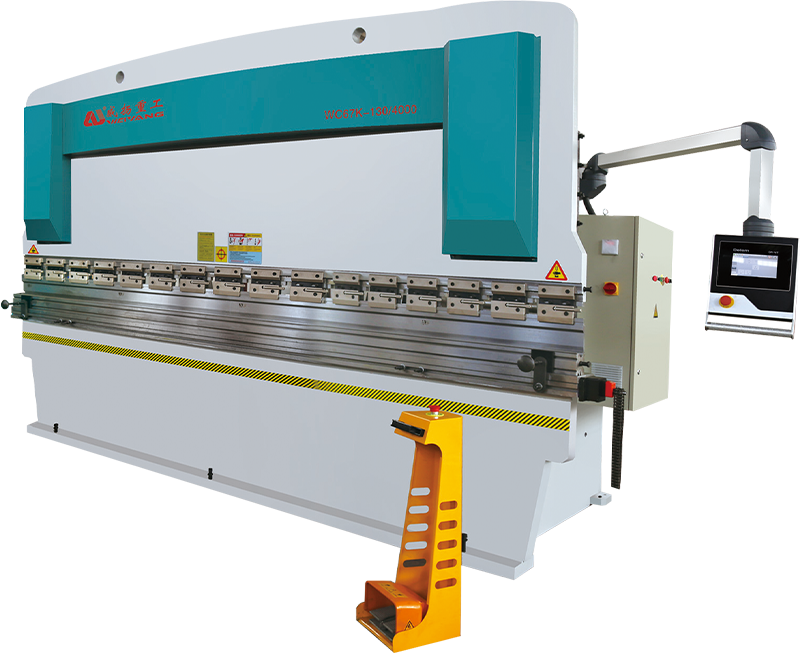
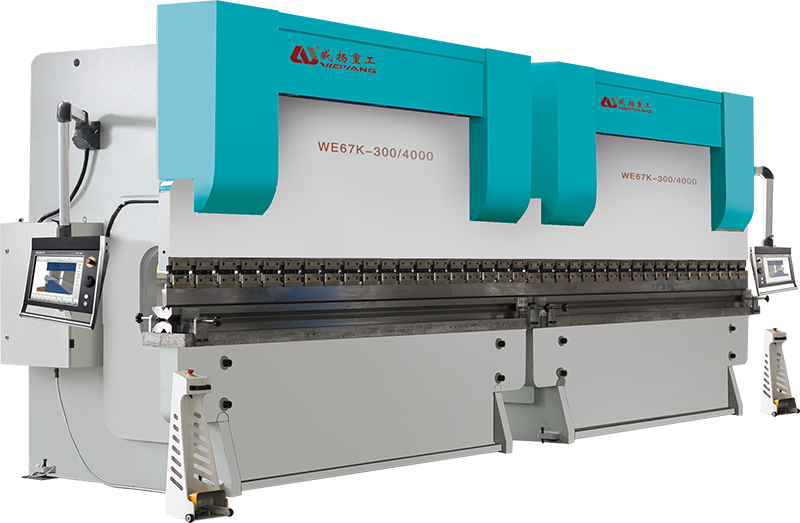
A shear also rarely stands alone. Shops that cut to length usually form immediately afterwards, which is why the machine is most often quoted alongside a press brake — for example, an electro-hydraulic synchronous servo model that shares the same drive philosophy:
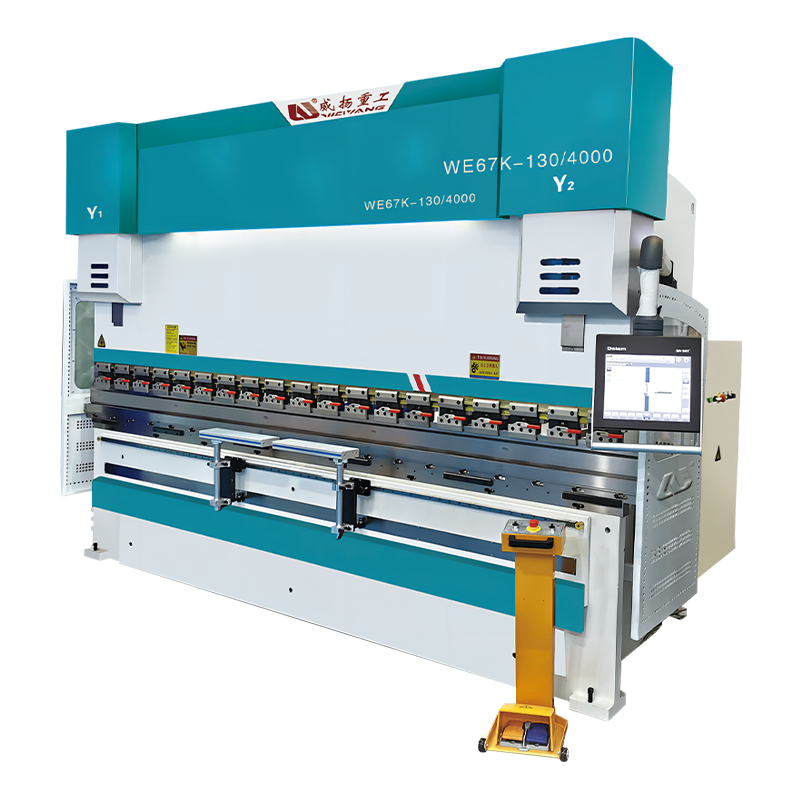 Electro-Hydraulic Synchronous Servo Bending MachineShops that shear to length usually bend right afterwards, so this servo bending machine is commonly quoted alongside a shear. Its electro-hydraulic synchronous drive pairs naturally with modern cutting lines.View Product →
The Buying Checklist That Prevents Expensive Regrets
Most disappointing shear purchases trace back to three avoidable mistakes: buying capacity without mapping the real material mix, ignoring how blade clearance is adjusted, and treating after-sales as an afterthought. Walk the list in order.
- Map the material matrix first: thickest and thinnest sheet, longest cut, material mix and weekly volume. Capacity must hold at full length, not just at maximum thickness.
- Match machine type to duty — swing beam for thin-to-medium batches, gate for long, thick or relentless schedules.
- Inspect the clearance adjustment: motorized quick-set versus manual, and how long a full-width change actually takes.
- Verify the backgauge: travel, repeatability, and support fingers or extension arms for long sheets.
- Check the safety package: finger guard, hold-down visibility, rear fencing, emergency stops and local compliance marks.
- Count the cycle: strokes per minute at working stroke, and whether programmable stroke length saves time on short parts.
- Total the ownership cost: spare blade sets, hydraulic oil and filtration, seals, commissioning and spares lead time.
The reason for that order becomes obvious once materials change:
| Material | Force vs. Mild Steel | Practical Consequence |
|---|---|---|
| Mild steel | 1.0 (baseline) | Nameplate rating applies as stated |
| Stainless (304) | ~1.5× | Derate maximum thickness by roughly one third |
| Aluminum | ~0.6× | Watch for too-wide clearance causing bent or clipped edges |
| High-tensile steel | Varies widely | Confirm with the manufacturer before committing |
Warning: Never size a machine on mild-steel ratings if stainless dominates your mix. Shearing 304 stainless takes roughly one and a half times the force of mild steel at the same thickness, and running a rated machine at its stainless limit every cycle shortens blade and seal life.
What Keeps a Shear Accurate for Years
Edge quality is your maintenance dashboard. A rising burr means the blades need rotating or resharpening. A drifting backgauge points to ball-screw backlash. Sluggish strokes or a warm oil tank mean the oil or filters need attention before a valve does.
- Keep the hydraulic oil inside the cleanliness class the manufacturer specifies; contamination is the leading cause of valve faults
- Rotate blades through all four edges before committing to a resharpen
- Verify hold-down pressure periodically — slipping sheets ruin edges and gauges alike
- On swing beam machines that return the ram on nitrogen, check the charge annually
- Log stroke counts and blade changes so resharpening is scheduled, not reactive
Success: Clean oil, sharp blades and a correctly set clearance are the entire formula. Shops that hold those three parameters routinely measure blade life and gauge repeatability in years rather than months.
Danger: Blade changes and clearance adjustments are lockout procedures, not quick jobs. Isolate the electrical supply, release hydraulic pressure, and keep hands behind the finger guard whenever the machine is energized.
The Short Answer
An electric hydraulic shearing machine is the pragmatic center of sheet-metal cutting: hydraulic cylinders deliver the tonnage, an electric motor and electronic valves deliver the control, and the controller ties accuracy to repeatability. Choose swing beam for thin-to-medium batch work and gate for long, thick or continuous duty. Verify clearance adjustment, backgauge precision and the safety package in person, derate honestly for stainless, and maintain oil and blades on a schedule. Do those four things, and the machine will still be cutting straight, quiet, burr-free edges long after the invoice is forgotten.
Related Product


-
 +86-13813747229
-
 [email protected]
-
 No. 22 Haifang Avenue, Chengdong Town, Hai'an City, Jiangsu Province,China.
Copyright © 2024Jiangsu Weiyang Heavy Industry Technology Co., Ltd. All Rights Reserved.
Custom Hydraulic Power CNC Press Brake Machines Manufacturers
