


Hydraulic Shearing Machine Working Principle: How Hydraulic Shears Cut Sheet Metal
The hydraulic shearing machine cuts sheet metal by moving a straight upper blade down past a fixed lower blade. The cutting force comes from hydraulic cylinders, and the quality of the edge depends more on setup than on the machine's rated power. Blade gap, rake angle, and the condition of the blades determine whether you get a clean square edge or a part that needs secondary finishing. This article explains the working principle of a hydraulic shearing machine, what each component does, and what to look for when choosing one.
What Is a Hydraulic Shearing Machine?
A hydraulic shearing machine is a floor-standing tool designed to cut sheet metal and plate in straight lines. It uses a hydraulic circuit to push the ram and upper blade down against the workpiece, while the lower blade remains fixed. Common materials include mild steel, stainless steel, aluminum, and copper alloys. Most machines are built around a welded steel frame with a cutting table, hold-down clamps, a back gauge, and a control system.
The key difference from a mechanical shear is the drive. A mechanical shear uses a flywheel and crankshaft to create a fixed cycle. A hydraulic shear can adjust stroke length and cutting force for each cycle, which reduces stress on the machine and makes the cutting action easier to control.
How Does a Hydraulic Shearing Machine Work?
Hydraulic Force Generation
Hydraulic shears rely on Pascal's law: pressure applied to a confined fluid is transmitted equally in all directions. An electric motor drives a hydraulic pump, which sends oil through valves to the main cylinders. Because the cylinder piston area is much larger than the pump outlet, the pressure is converted into a large cutting force. For example, a system operating at 200 bar on a cylinder with a 0.01 m² piston area can generate about 200,000 N, or roughly 20 tonnes of force.
Relief valves limit system pressure and prevent overloading. In many modern shears, a variable-displacement pump adjusts oil flow to match cutting speed, so the machine only uses energy when the ram is actually moving. The hydraulic system on a CNC shearing machine also controls the hold-down force, back gauge positioning, and blade return sequence. That integration is what makes hydraulic shears accurate and repeatable over long production runs.
The Cutting Action
At the top of the stroke, the upper blade is slightly higher than the material. When the cycle starts, the hold-down clamps press the sheet against the table. Then the upper blade moves down, cutting progressively from one side to the other. The upper blade is usually set at a small rake angle, so only a short length of blade contacts the material at any moment. This reduces the total cutting force and dampens vibration.
Blade gap is the distance between the upper and lower blades. A common rule is to set the gap at about 5 to 10 percent of the sheet thickness. Too small a gap increases blade wear and can damage the machine; too large a gap creates burrs and a twisted edge. The correct gap also depends on material type and tensile strength.
Typical Working Cycle
- The back gauge positions the sheet at the required cutting width.
- The hold-down clamps lower to secure the plate.
- The main cylinders push the upper blade down to shear the material.
- The ram rises after cutting and the clamps release.
- The operator advances the sheet for the next cut, or the back gauge moves automatically on CNC models.
This sequence is straightforward, but every step affects cycle time and edge quality. A weak hold-down, a worn blade, or an incorrect gap can ruin a batch.
Key Components of a Hydraulic Shearing Machine
| Component | Function |
|---|---|
| Frame and cutting table | Supports the workpiece and absorbs cutting forces. |
| Hydraulic cylinders | Convert oil pressure into downward ram force. |
| Hydraulic pump and valves | Generate, direct, and control oil flow and pressure. |
| Upper and lower blades | Perform the actual shearing cut. |
| Hold-down clamps | Prevent the sheet from lifting or moving during cutting. |
| Back gauge | Positions the sheet for accurate cutting width. |
| Electrical control system | Manages stroke, pressure, back gauge, and safety interlocks. |
Two Common Types: Swing Beam and Guillotine
There are two common configurations for hydraulic shears. A hydraulic swing beam shearing machine uses a pivot-mounted upper blade. The blade follows an arc, which helps maintain a consistent blade gap through the stroke. This design is simple, cost-effective, and popular for general sheet metal work.
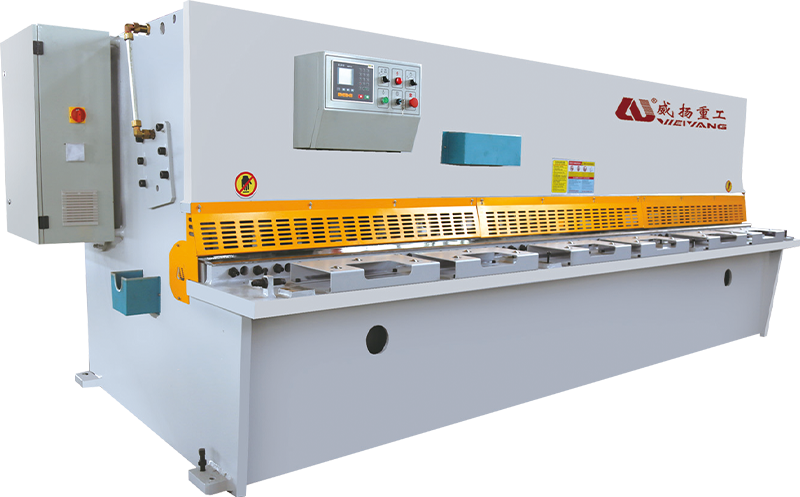 CNC Hydraulic Swing Shearing Machine Manufacturers, FactoryAs China hydraulic swing shearing machine manufacturers and CNC swing shearing machine factory, Jiangsu Weiyang Heavy Industry Technology...View Product →
A guillotine shear has a vertically guided upper blade that moves in a straight line. The frame is generally heavier and more rigid, making it better suited for thicker plates and demanding cutting schedules. It also allows more precise blade-gap adjustment.
Choose a swing beam for lighter, everyday cutting. Choose a guillotine if you work mostly with thicker plate, need a cleaner edge, or plan to run continuous production.
Typical Applications
Hydraulic shears are used wherever flat metal needs precise straight cuts. In metal fabrication, they prepare blanks for bending, punching, or welding. In the aviation industry, they cut aluminum sheets and thin stainless steel used in interior panels and structural parts; you can see this in our aviation industry case. In machinery building, they cut steel plates for frames, guards, and brackets. In light industry, they support production of electrical enclosures, cabinets, and stainless steel products.
Because cutting is done without heat, the edges are clean and free of oxidation, which is important for parts that will later be formed or welded.
What to Look For When Choosing a Hydraulic Shearing Machine
- Cutting capacity: Check both maximum thickness and maximum length against the materials you actually process. Thinner but wide sheets can still be difficult for a machine with a short table.
- Blade gap adjustment: Models with powered or quick-adjust gap control reduce setup time.
- Stroke length: A shorter stroke speeds up cycles, while a longer stroke may be needed for sheet with significant bow or for slitting operations.
- Back gauge control: A handheld or CNC back gauge improves accuracy and repeatability.
- Frame rigidity: A heavier frame reduces deflection and gives a more consistent cut across the full length.
- Safety features: Look for two-hand controls, protective rear guards, and hydraulic overload protection.
Do not buy on price alone. Ask the manufacturer to run a test cut with your material and show you the burr height and edge straightness. If the edge is clean and the machine holds the dimensions across several cuts, the design is sound.
If you cut mostly thick plate, a hydraulic guillotine shearing machine often gives the cleaner edge and better rigidity. For lighter production, a swing beam design is simpler and more cost-effective.
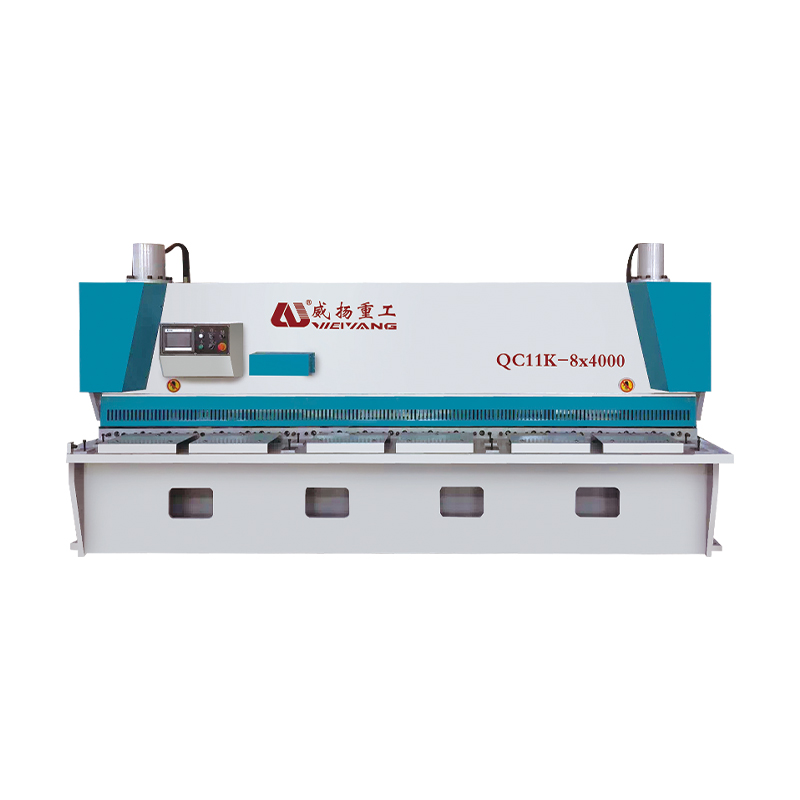 OEM/ODM CNC Gate shearing machine Factory, ManufacturersJiangsu Weiyang Heavy Industry Technology Co., Ltd. is China CNC Gate shearing machine factory and manufacturers, we offer OEM/ODM Gate s...View Product →
Safety and Maintenance
Safety on a hydraulic shear starts with operator training. Never bypass the rear guard or reach into the cutting area while the blade is moving. Keep the floor around the machine dry, and make sure the foot switch or palm buttons are protected from accidental activation. Two-hand operation is standard on most modern machines and should stay enabled.
Maintenance is equally important. Check the hydraulic oil level and temperature regularly; use the oil grade specified by the manufacturer. Replace filters according to the manual, and inspect hoses for leaks. Blades should be sharpened when the burr increases noticeably, and the blade gap must be reset after sharpening.
A clean hydraulic system is the most reliable safety device on the machine. Most unplanned stoppages come from contaminated oil, worn seals, or a loose blade.
Working Principle and Practical Selection
The working principle of a hydraulic shearing machine is consistent across models: hydraulic pressure pushes a blade through sheet metal with controlled force, while blade gap and rake angle determine the quality of the cut. Understanding these factors helps you use a shear more effectively and select equipment that fits your production.
If you are comparing swing beam and guillotine shears, test both on your materials. Check how easily the gap is adjusted, how rigid the table feels, and how the machine behaves under load. Those observations tell you more than a specification sheet.
Related Product

-
 +86-13813747229
-
 [email protected]
-
 No. 22 Haifang Avenue, Chengdong Town, Hai'an City, Jiangsu Province,China.
Copyright © 2024Jiangsu Weiyang Heavy Industry Technology Co., Ltd. All Rights Reserved.
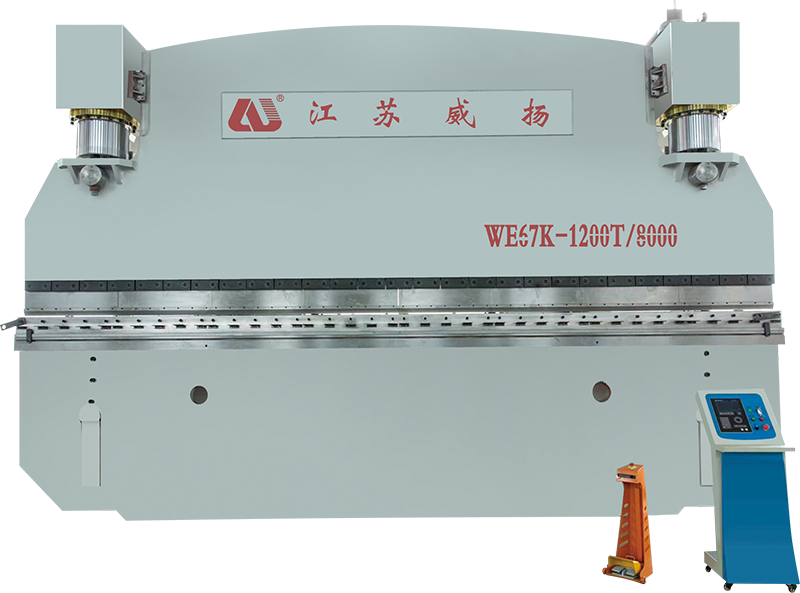
Custom Hydraulic Power CNC Press Brake Machines Manufacturers
