Two machines. One plate. Two very different outcomes. When precision is the deliverable, the difference between a three-roll and a four-roll rolling machine is not academic — it is measured in millimeters, in scrap rates, and in whether a cylinder passes inspection the first time.
Direct Answer: Four Rolls Win on Accuracy
For the same plate thickness, a 4-roll rolling machine consistently produces tighter roundness tolerances than a 3-roll asymmetrical machine, typically achieving deviations within 1–2mm on medium-to-heavy plate versus 2–4mm on a comparable 3-roll unit. This gap exists because the 4-roll design uses a top pinch roll and two side rolls that hold the plate firmly in position throughout the entire bending cycle, eliminating the plate slippage and repositioning errors common with 3-roll asymmetrical machines.
CNC rolling machine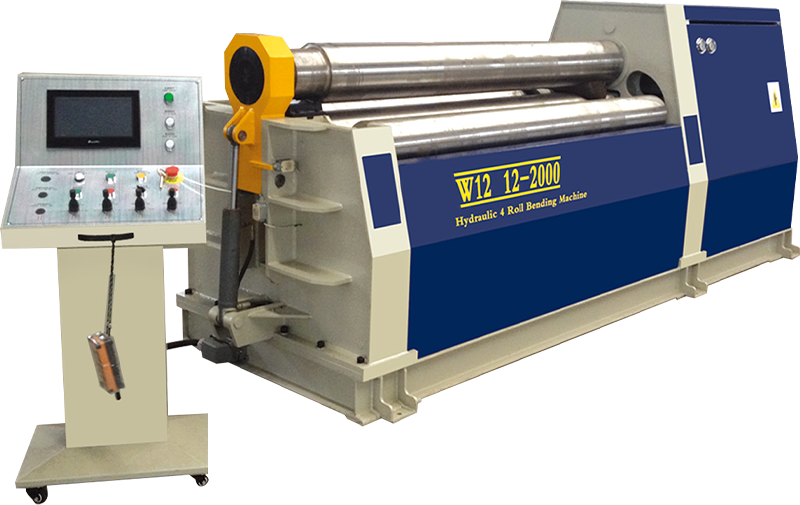
If your project requires precise cylindrical or conical shapes with minimal out-of-round error, a 4-roll machine is the more reliable choice. A well-maintained 3-roll asymmetrical machine, however, can still meet acceptable tolerances for less demanding applications — often at a meaningfully lower investment.
Why the Roll Configuration Changes Everything
The core reason for the accuracy difference lies in how each machine handles the plate during forming. A 3-roll asymmetrical machine uses one top roll and two adjustable side rolls, with the plate pinched only on one side at a time. The operator must reposition the plate manually to bend the leading and trailing edges — and every repositioning introduces a small alignment error.
A 4-roll machine, by contrast, clamps the plate between a top and bottom pinch roll while two side rolls perform the actual bending. Because the plate never needs to be released and repositioned, the entire forming sequence happens under continuous, consistent pressure.
Plate Clamping and Slippage
Slippage during rolling is one of the most common causes of dimensional inconsistency. In a 3-roll asymmetrical setup, the plate can shift slightly as it passes between rolls, especially near the edges. A 4-roll configuration reduces this risk substantially, which is why fabricators processing precision cylinders tend to favor it despite the higher cost.
Edge Flatness and Pre-Bending
Another accuracy factor is the flat, unrolled section left at the plate's edges. On a 3-roll asymmetrical machine, some flat edge typically remains unless the operator performs a separate pre-bending pass — adding time and human error. A 4-roll machine's pinch rolls minimize this flat section automatically, producing a more uniform curvature edge to edge in a single pass.
The accuracy gap is not fixed — it widens as plate thickness increases, because thicker material demands more even force distribution across the entire clamping surface.
Accuracy Data by Plate Thickness
Field data collected from typical fabrication shops shows a measurable gap between the two machine types across different thickness ranges, based on standard industrial testing conditions.
| Plate Thickness | 3-Roll Asymmetrical | 4-Roll |
|---|---|---|
| 6mm | 1.5mm | 0.8mm |
| 12mm | 2.5mm | 1.2mm |
| 20mm | 3.5mm | 1.8mm |
| 30mm | 4.2mm | 2.1mm |
As thickness increases, the 3-roll asymmetrical machine's single-side pinch mechanism struggles to maintain consistent pressure across a wider plate surface. The 4-roll machine's dual-pinch design compensates by distributing clamping force evenly — a meaningful advantage in pressure vessel and shipbuilding work.
The Role of CNC Control
Beyond roll configuration, control systems play a significant role in final accuracy. Many modern 4-roll machines are now offered as a cnc plate rolling machine, where roll positioning, bending angle, and feed rate are managed by computer numerical control rather than manual adjustment — removing much of the operator-dependent variation that affects manually controlled 3-roll asymmetrical machines.
Repeatability Across Production Runs
Repeatability often matters more than single-piece accuracy in production. A CNC-controlled 4-roll machine can store bending programs and repeat the same roll positions across hundreds of parts, typically within 0.5mm of the original setup. A manually operated 3-roll asymmetrical machine, even under a skilled technician, tends to show greater part-to-part variation.
Real-Time Feedback and Correction
Some higher-end 4-roll systems include real-time sensors that measure curvature during rolling and automatically adjust pressure to correct deviations before the part is finished — a closed-loop capability rarely found on entry-level 3-roll asymmetrical machines.
Practical Factors That Influence Real-World Accuracy
Machine design sets the theoretical accuracy ceiling. Several practical factors determine how close a shop actually gets to it in daily operation.
- Operator experience and familiarity with the specific machine's controls
- Roll wear and maintenance frequency, since worn rolls introduce inconsistent friction
- Material consistency, including thickness variation within the plate itself
- Ambient temperature, which can affect material stiffness during cold rolling
- Calibration schedule for CNC-equipped machines, since sensor drift reduces accuracy gains over time
Weighing Accuracy Against Cost
Accuracy improvements from a 4-roll machine come with a higher upfront investment. When researching cnc rolling machine price ranges, buyers typically find that 4-roll CNC units cost 30% to 60% more than comparable 3-roll asymmetrical machines of similar tonnage — reflecting the extra pinch roll, more complex hydraulics, and in CNC models, the control software and sensor package.
When the Extra Cost Is Justified
For pressure vessels, aerospace components, or any part with strict roundness tolerances, the accuracy gained from a 4-roll machine typically pays for itself through reduced scrap and rework. A shop that cuts rework from 8% to 2% on a high-volume cylindrical line can recover the price difference within one to two years.
When a 3-Roll Machine Remains the Better Choice
For general fabrication, ductwork, or projects where 3–4mm tolerances are acceptable, a 3-roll asymmetrical machine remains cost-effective. Its simpler mechanical design also means lower long-term maintenance costs and easier troubleshooting.
Summary Comparison
| Factor | 3-Roll Asymmetrical | 4-Roll |
|---|---|---|
| Roundness tolerance | Moderate | High |
| Edge flatness | Requires pre-bending pass | Minimal flat edge |
| Repeatability | Operator dependent | Consistent, especially with CNC |
| Upfront cost | Lower | Higher |
Final Recommendation
If your work demands precise roundness, minimal edge flattening, and high repeatability across production runs, a 4-roll rolling machine, particularly a CNC-controlled model, offers a clear accuracy advantage over a 3-roll asymmetrical machine at the same plate thickness. This advantage becomes more pronounced as material thickness increases, making 4-roll machines the preferred choice for heavy-gauge, high-tolerance fabrication. Weigh this benefit against the higher cost, added maintenance complexity, and your shop's actual tolerance requirements before committing.