


How does the Hydraulic Power CNC Press Brake Machine's hydraulic system maintain consistent pressure when bending thick carbon steel plates?
Hydraulic Power CNC Press Brake Machine maintains consistent pressure during thick carbon steel bending through a closed-loop hydraulic control system that continuously monitors and adjusts oil pressure, ram position, and cylinder synchronization in real time. Unlike mechanical press brakes that deliver fixed force profiles, the hydraulic system on a modern CNC press brake actively compensates for material resistance variations, oil temperature changes, and load asymmetry — all of which become critically important when bending plates above 10 mm thickness.
The consistency of bending force directly determines angular accuracy, repeatability, and structural integrity of the finished workpiece. For thick carbon steel plates — including grades such as S355, A572 Gr.50, and high-strength low-alloy (HSLA) steels — even a 5% deviation in applied tonnage can produce angular errors exceeding 1–2°, which is unacceptable in structural and heavy fabrication applications.
The Core Architecture: How the Hydraulic Circuit Is Designed
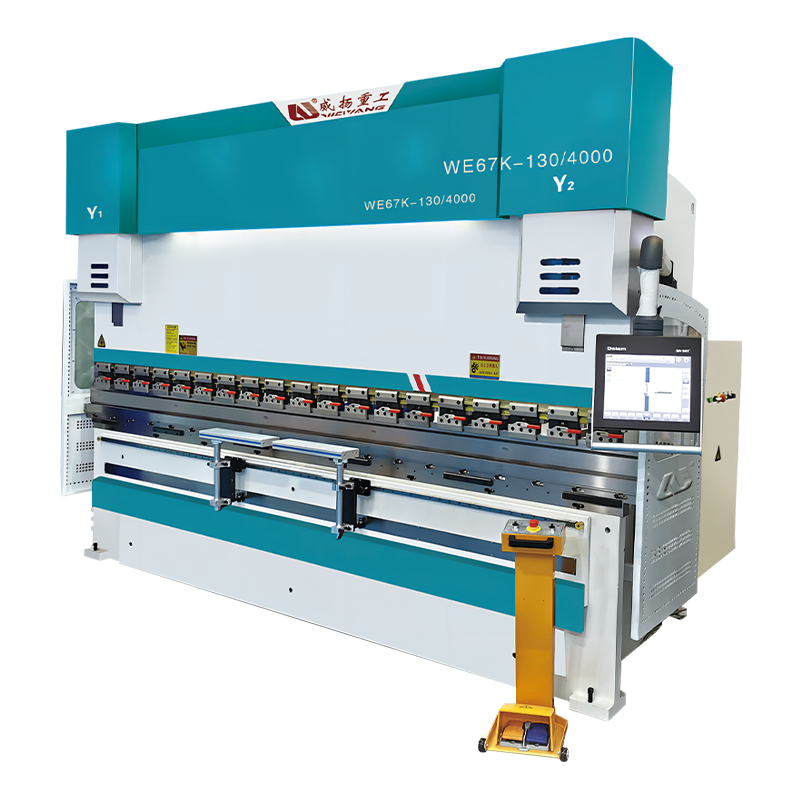
The hydraulic system of a Hydraulic Power CNC Press Brake Machine is engineered around a dual-cylinder configuration, with one cylinder (Y1) and one cylinder (Y2) positioned at each end of the ram. Both cylinders are fed by a common hydraulic power unit (HPU) but are independently controlled via separate proportional valves. This architecture is the foundation of consistent pressure delivery across the full bending length.
Key hydraulic circuit components include:
- Variable displacement axial piston pump: Delivers hydraulic oil at system pressures up to 250–350 bar, adjusting output flow in proportion to the actual load demand rather than running at fixed maximum pressure
- Proportional pressure relief valves: Set the maximum system pressure dynamically based on the CNC controller's tonnage calculation for each specific bend program
- Servo-proportional directional control valves: Regulate oil flow direction and speed to each cylinder with response times as fast as 5–15 ms, enabling real-time correction during the bending stroke
- Linear encoders on Y1 and Y2 axes: Provide position feedback with resolution typically at ±0.01 mm, allowing the CNC to detect any ram tilt and correct it immediately through differential pressure adjustment
- Pressure transducers: Monitor actual hydraulic pressure in each cylinder independently, feeding data back to the controller at rates exceeding 1,000 samples per second
Closed-Loop Pressure Control: Real-Time Feedback During Bending
The most critical mechanism for pressure consistency is the closed-loop feedback system that links the hydraulic valves, pressure sensors, and the CNC controller in a continuous correction loop. When bending thick carbon steel — where material resistance can vary by 10–15% across a single plate due to rolling tolerances and local hardness variations — open-loop hydraulic systems cannot maintain consistent force. The Hydraulic Power CNC Press Brake Machine addresses this with the following control sequence:
- The CNC calculates the required tonnage based on material thickness, tensile strength, die opening width, and bend length
- The target pressure is transmitted to the proportional pressure relief valve as an analog or digital setpoint
- As the ram descends and contacts the plate, actual cylinder pressure is measured by the transducers
- Any deviation between target and actual pressure triggers a correction signal to the proportional valve within milliseconds
- The valve adjusts oil flow to bring actual pressure back to the setpoint before angular error accumulates
This loop runs continuously throughout the bending stroke, not just at the bottom dead center. For thick plates, where the bending force can rise sharply in the final 2–5 mm of stroke, this real-time correction is what separates consistent production from variable results.
Y1/Y2 Synchronization: Preventing Ram Tilt Under Asymmetric Loads
When bending off-center loads — which is common when processing shorter thick-plate workpieces on a long machine — one cylinder experiences significantly higher resistance than the other. On a Hydraulic Power CNC Press Brake Machine, the CNC synchronization system actively manages differential pressure between Y1 and Y2 to keep the ram parallel within ±0.01 mm over the full working length.
Without synchronization control, asymmetric thick-plate bending would cause the ram to tilt, producing a wedge-shaped angle across the bend length — a defect called angular twist. The correction mechanism works by:
- Comparing Y1 and Y2 encoder positions 1,000+ times per second
- Increasing oil pressure to the lagging cylinder and reducing it to the leading cylinder proportionally
- Completing the correction within 5–20 ms to prevent any measurable position error from developing
For a 500-ton Hydraulic Power CNC Press Brake Machine bending 20 mm S355 plate, the differential load between Y1 and Y2 during an off-center bend can reach 80–120 tons. Active synchronization absorbs this imbalance without any angular deviation at the workpiece.
Oil Temperature Management and Its Effect on Pressure Stability
Hydraulic oil viscosity changes significantly with temperature. At 20°C, a typical ISO VG 46 hydraulic oil has a viscosity of approximately 46 cSt. At 60°C — a common operating temperature after extended thick-plate bending cycles — viscosity drops to roughly 15–18 cSt. This reduction affects valve response characteristics and leakage rates across seals, both of which influence the actual pressure delivered to the cylinders.
A well-engineered Hydraulic Power CNC Press Brake Machine addresses this through:
Oil Cooling Systems
Air-cooled or water-cooled heat exchangers maintain oil temperature within a controlled band, typically 40–55°C during continuous operation. Thermostatically controlled cooling activates when oil temperature exceeds the setpoint, preventing viscosity-driven pressure drift over long production shifts.
Warm-Up Cycles
Modern Hydraulic Power CNC Press Brake Machines include automatic warm-up programs that circulate oil through the system at low pressure before production starts. This brings oil to operating temperature (typically 35–40°C) before the first bend is executed, ensuring valve calibration and pressure response are stable from the first stroke.
Temperature-Compensated Valve Control
High-end systems incorporate oil temperature as a variable in the proportional valve control algorithm. As temperature rises and viscosity drops, the controller adjusts valve gain parameters to maintain the same effective pressure response — compensating for what would otherwise be an increasing tendency toward pressure overshoot.
Pressure Requirements: Thick Carbon Steel Grades Compared
Different carbon steel grades impose very different pressure demands on the Hydraulic Power CNC Press Brake Machine's hydraulic system. The table below illustrates representative tonnage requirements for bending common structural and high-strength steels at 20 mm thickness across a 1-meter bend length, using a die opening of 160 mm (8× material thickness):
| Steel Grade | Tensile Strength (MPa) | Required Tonnage (20mm × 1m) | Springback | Pressure Stability Demand |
|---|---|---|---|---|
| S235 / A36 | 360–510 | ~280 tons | 2–3° | Moderate |
| S355 / A572 Gr.50 | 490–630 | ~380 tons | 3–5° | High |
| S460 / HSLA 460 | 540–720 | ~460 tons | 5–7° | Very High |
| Hardox 400 | 1,250 (min) | ~900+ tons | 8–12° | Extreme |
As tensile strength increases, so does the sensitivity of the finished angle to any pressure variation. A 3% pressure fluctuation when bending Hardox 400 at 20 mm can produce an angular error of 0.5–1°, which would require costly rework or scrapping of the workpiece.
The Role of the CNC Controller in Hydraulic Pressure Management
The CNC controller is the intelligence layer that translates bending program parameters into precise hydraulic commands. On a Hydraulic Power CNC Press Brake Machine configured for thick carbon steel work, the controller performs several pressure-related functions that go beyond simple on/off valve switching:
Tonnage Pre-Calculation
Before each bend, the CNC calculates the required hydraulic pressure using the formula incorporating material yield strength, thickness squared, bend length, and die opening. This prevents the system from starting at an incorrect pressure setpoint — a common cause of first-piece angular error in manual and semi-automatic machines.
Multi-Stage Pressure Profiling
Rather than applying full tonnage from the start of the stroke, advanced Hydraulic Power CNC Press Brake Machine controllers apply a multi-stage pressure profile: rapid approach at low pressure, deceleration to bending speed at the pinch point, full pressure application during the bending stroke, and controlled pressure release during retraction. This profile reduces hydraulic shock, extends seal life, and prevents plate bounce that could cause angular inconsistency.
Adaptive Pressure Correction Based on Angle Measurement
When equipped with an in-process angle measurement system (laser or contact-type), the Hydraulic Power CNC Press Brake Machine can measure the actual bend angle mid-stroke and adjust the final penetration depth — effectively modifying the force application — to compensate for material variation. This is particularly valuable when bending thick plates from the same batch that have yield strength variation of ±10%, which is within standard EN 10025 tolerances for S355.
Hydraulic System Maintenance Practices That Protect Pressure Consistency
Even the most precisely engineered hydraulic system will lose pressure consistency if maintenance is neglected. For a Hydraulic Power CNC Press Brake Machine regularly processing thick carbon steel — which demands high and sustained hydraulic pressure — the following maintenance intervals are critical:
- Hydraulic oil replacement: Every 2,000–4,000 operating hours or annually — degraded oil increases internal leakage past valve spools, causing pressure drop under load
- Filter replacement: Every 500–1,000 hours — clogged filters restrict flow and cause pressure differential across the filter that the pump must overcome, reducing net cylinder pressure
- Cylinder seal inspection: Annually or upon detection of external leakage — bypassing seals under high pressure (200+ bar) cause pressure bleed-off during the hold phase of thick-plate bending
- Proportional valve calibration: Every 6–12 months — valve spool wear shifts the pressure-current curve, meaning the same electrical command delivers a different pressure than when the machine was commissioned
- Accumulator pre-charge pressure check: Every 6 months — hydraulic accumulators assist in maintaining pressure during the peak-load phase of thick plate bending; loss of nitrogen pre-charge reduces their buffering capacity
Shops that track their Hydraulic Power CNC Press Brake Machine's angular repeatability over time — logging first-piece angle versus programmed angle across production runs — often identify hydraulic degradation before it causes scrap, because the trend shows gradually increasing angular error that correlates with deferred maintenance intervals.
Electro-Hydraulic Servo Systems vs. Conventional Hydraulic Press Brakes
Not all hydraulic press brakes offer the same level of pressure control. The distinction between conventional relay-controlled hydraulic systems and modern electro-hydraulic servo systems is significant for thick carbon steel applications:
| Feature | Conventional Hydraulic Press Brake | Electro-Hydraulic Servo CNC Press Brake |
|---|---|---|
| Pressure control method | Manual relief valve, fixed setpoint | Proportional valve, dynamic CNC setpoint |
| Ram position feedback | None or mechanical stop | Linear encoder ±0.01 mm |
| Y1/Y2 synchronization | Mechanical torsion bar only | Active electronic sync, ±0.01 mm |
| Angular repeatability | ±0.5–1.5° | ±0.1–0.3° |
| Thick plate suitability | Limited — manual re-adjustment needed | Fully capable with automatic correction |
For production environments where thick carbon steel plates are a regular workload, the electro-hydraulic servo Hydraulic Power CNC Press Brake Machine is not optional — it is a technical necessity for achieving the angular tolerances demanded by structural, offshore, and heavy equipment manufacturing standards.
Related Product
-
 +86-13813747229
-
 [email protected]
-
 No. 22 Haifang Avenue, Chengdong Town, Hai'an City, Jiangsu Province,China.
Copyright © 2024Jiangsu Weiyang Heavy Industry Technology Co., Ltd. All Rights Reserved.
Custom Hydraulic Power CNC Press Brake Machines Manufacturers
