


Hydraulic Plate Shearing Machine: Working Principle, Components & Buying Tips
A shop owner contacted us last year because a new hydraulic shear was leaving burrs on 3 mm stainless steel. Hydraulic pressure was correct, blades were new, yet every cut showed a rough edge. The fault was the blade gap: it had been set for 8 mm plate and never adjusted. That single detail explains why the blade gap is the first thing to check when a hydraulic plate shearing machine does not cut cleanly, and why you should understand the core working principle before comparing price lists.
What a hydraulic plate shearing machine actually does
A hydraulic plate shearing machine is built for one task: cutting straight lines across flat metal sheet and plate. A hydraulic cylinder set pushes a beam down, driving the upper blade past a fixed lower blade. The material is clamped firmly against the table, and as the blades cross, the sheet separates along a clean line.
The hydraulic drive offers two advantages over older mechanical shears. The first is overload protection: the pump stops building pressure once the cutting force reaches its limit, so a one-off mistake does not break the machine. The second is adjustable stroke control: the blade travels only deep enough to complete the cut, which shortens cycle time and saves energy on every stroke.
Although the sequence sounds simple, the commercial difference between a cheap machine and a consistent one is hidden in the details: the rigidity of the frame, the precision of the blade gap setting, and the repeatability of the back gauge.
How the cutting cycle runs
A typical cutting cycle on a modern hydraulic shear takes only a few seconds. Each phase is controlled:
- The operator feeds the sheet against the back gauge, which positions the cut line automatically or with manual control.
- The hold-down cylinders lower the clamping feet and press the sheet against the machine table.
- The main hydraulic cylinders drive the blade beam downward; the upper blade enters the material at a preset rake angle.
- The shear force propagates across the sheet, and the cut completes along the full width.
- The beam returns to the top position and the hold-downs release, allowing the operator to advance the sheet for the next cut.
The duration of each phase depends on pump flow, cylinder size and the control system. Machines with a CNC back gauge and automatic blade gap control reduce the operator's decisions to a set of coordinates. For a closer look at how the hydraulic circuit supports repeatable strokes, see our analysis of the hydraulic system in CNC shearing machines.
Five components that decide cut quality and blade life
Cut quality depends more on five components than on the nominal tonnage of the machine.
| Component | Main role | Effect when out of adjustment |
|---|---|---|
| Hydraulic cylinders | Generate the cutting force and control blade speed | Slow approach, weak cutting power and uneven stroke |
| Blade gap adjustment | Sets the distance between the upper and lower blade edges | Too wide creates roll-over and burrs; too narrow shortens blade life |
| Rake angle adjustment | Controls the angle at which the upper blade descends | Excessive rake increases deformation on thin sheet |
| Hold-down system | Presses the sheet against the machine table | Weak clamping allows sheet movement and dimensional errors |
| Back gauge | Positions the sheet accurately for each cut | Backlash or wear causes width inconsistency between parts |
Blade gap: the most misunderstood setting
Fabricators use a practical rule of thumb: the gap between the upper and lower blades should be between 5 and 10 percent of the sheet thickness. For a 6 mm mild steel plate, that means about 0.3 to 0.6 mm, closer to the lower value for soft materials and closer to the higher value for hard ones. On manual machines the operator must loosen screws, shift the blade and retighten; on CNC models the adjustment is motorized and stored as part of the thickness parameters. That is why fabricators with frequent material changes tend to choose CNC-controlled blade gap.
Rake angle: the hidden variable
Raising the rake angle reduces the required cutting force, which allows a lighter frame, but it also increases vertical deformation on the sheet edge. Most swing-beam shears have a fixed rake angle around 1 to 1.5 degrees, while gate shears allow a wider range, often up to 3 degrees. A machine with a fixed rake angle is less flexible when the material range is very wide.
Hold-down force and the back gauge: the last 0.1 mm
Clamping pressure must be high enough to prevent the sheet from lifting, but on polished or coated sheet, excessive pressure leaves visible marks. Adjustable hold-down pressure solves that conflict. The back gauge, meanwhile, must return to the same position after every feed; heavy-duty machines achieve this with ball-screw drives and brakes rather than belts.
Swing-beam or gate shear: matching the machine to your workload
The two dominant configurations are swing-beam shears and gate shears. The choice affects not only the sticker price but also the range of materials you can process and how easily you can adjust the cutting parameters.
| Parameter | Swing-beam shear | Gate shear |
|---|---|---|
| Blade movement | Upper blade swings around a fixed pivot | Blade beam travels vertically in guide rails |
| Rake angle | Fixed or narrow adjustment range | Adjustable over a wider range |
| Practical thickness range | About 1–8 mm in most shops | About 4–25 mm and beyond |
| Frame structure | Lighter, often C-frame | Heavier, more rigid |
| Maintenance | Fewer moving parts, lower service cost | More guide surfaces to keep aligned |
| Typical investment | Lower | Higher |
When a swing-beam shear is the right answer
If most of your work is between 1 mm and 6 mm, with occasional changes in material type, a swing machine is simple to run and easy to maintain. Many light-industry and sheet-metal shops use this configuration as the primary cutting station. A swing shearing machine configured for daily production usually covers the workload well and leaves budget for tooling and training.
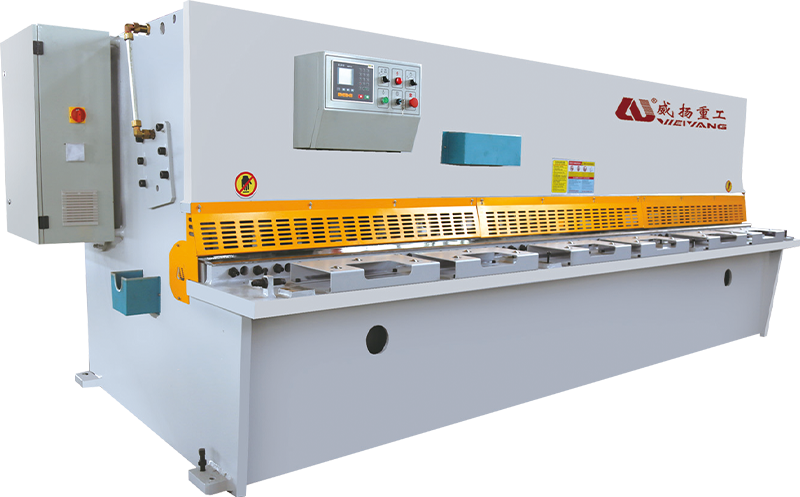 CNC Hydraulic Swing Shearing Machine Manufacturers, FactoryAs China hydraulic swing shearing machine manufacturers and CNC swing shearing machine factory, Jiangsu Weiyang Heavy Industry Technology...View Product →
When a gate shear earns the higher investment
Shops that cut plate over 6 mm, or that need dimensional consistency across large batches, benefit from a gate design. The vertical travel of the blade keeps the cut line perpendicular to the sheet, and the adjustable rake angle makes it possible to cut both thin and thick material on one machine. For continuous operation in machinery industry production lines, a gate shearing machine built for heavy plate work holds its accuracy far longer than a lightweight swing machine.
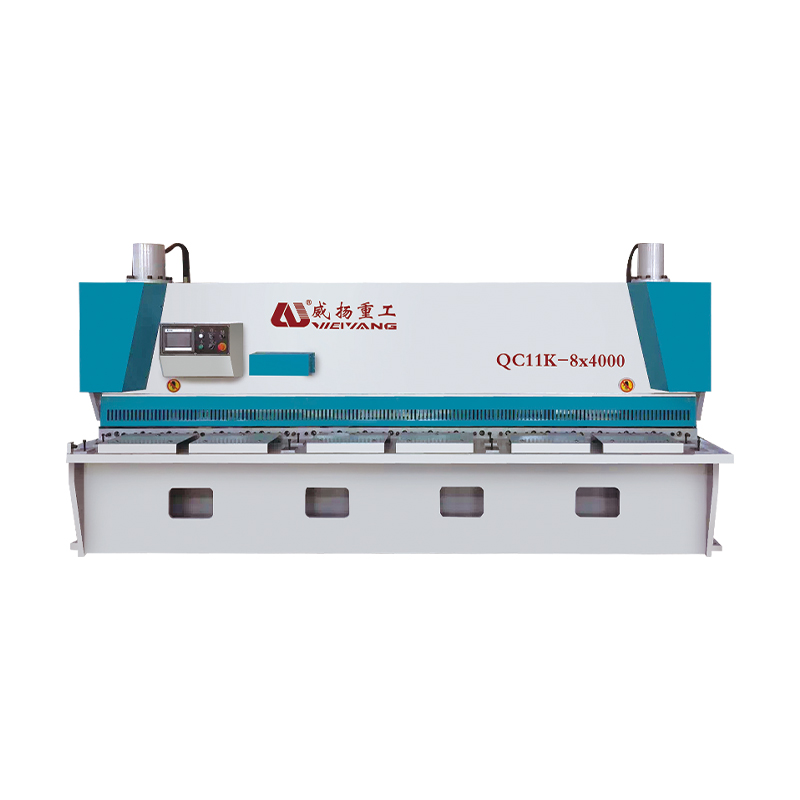 OEM/ODM CNC Gate shearing machine Factory, ManufacturersJiangsu Weiyang Heavy Industry Technology Co., Ltd. is China CNC Gate shearing machine factory and manufacturers, we offer OEM/ODM Gate s...View Product →
Real cutting capacity depends on material, not only the spec sheet
Rated thickness figures are almost always based on low-carbon structural steel such as S235JR or ASTM A36. Tensile strength changes the picture completely:
- Mild steel (S235JR or A36): full rated thickness.
- Stainless steel grade 304 or 316: roughly 70–80 percent of the rated thickness.
- Soft aluminum alloys (5052): up to 120–130 percent of the rated thickness, with a wider blade gap.
- Spring steel or other high-tensile materials: not suitable for straight shearing; use a laser or plasma line instead.
The practical rule is simple: rated thickness is a mild-steel value, and every other grade has to be scaled by tensile strength. A machine rated at 6 mm mild steel typically handles no more than 4.5–5 mm of stainless steel 304, while the same machine can process up to 7–8 mm of soft aluminum without reaching the hydraulic system's limit. Keep the blade gap adjusted for each new material batch; the wider the gap, the lower the cutting force, but also the rougher the edge.
Why hydraulic shearing stays economical for straight cuts
Every cutting method has a cost structure. Laser cutting offers flexibility, but the running cost per meter for a simple straight cut is high because of energy, assist gas and lens life. Plasma cutting handles thick plate, but it leaves a heat-affected zone that may need grinding and produces noise and fumes. A hydraulic shear produces a cold cut with no thermal effect and no edge hardening, and each stroke costs only the electrical energy of the pump motor. For high-volume blanks and strips, it remains the lowest-cost option per cut.
Shearing is not the right answer for internal cutouts or curved contours. In those cases, pair the shear with a laser cutter or punch press. The strongest production lines use the shear for straight edges and the laser for geometry, rather than expecting one machine to do everything.
What to verify before you order
The price difference between two hydraulic shears with the same nominal tonnage can be 30 percent or more. The difference usually shows up in components that do not appear in the spec sheet. Here is the checklist we use when a customer asks us to quote a machine:
- Check the maximum sheet thickness at your most common material strength, not just the mild-steel rating.
- Verify the blade gap adjustment range, and whether it is manual or motorized; a range that cannot cover both thin and thick material will force constant maintenance.
- Confirm the rake angle range, especially if you plan to cut thin sheet on a large machine.
- Inspect the hold-down pressure adjustment, to avoid marking polished or coated sheets.
- Test the back gauge repeatability; look for ball-screw drives and guides rather than a simple belt assembly.
- Ask about the availability of spare blades and hydraulic seals from the local supplier.
- Look for a manufacturer with machining depth; a producer with internal machining and over 20,000 square meters of production space can respond faster when a replacement part is needed.
Beyond the specifications, consider the machine's application history. A shear running in aviation sheet-metal work needs a different configuration from one feeding a light-industry production line. A good supplier adapts the hold-down pressure, blade angle and back gauge accuracy to the intended workload, and shows reference installations rather than only a datasheet.
Final selection logic
Start with your material list and thickness range. That tells you whether a swing-beam or a gate shear is the right structure. Then check the blade gap and rake angle adjustment ranges, because those determine how much flexibility you will have over time. Invest in a reliable hold-down and back gauge, since their accuracy decides the consistency of your cut parts. Finally, choose a manufacturer with the production depth and after-sales network to keep the machine cutting for years. A hydraulic plate shearing machine is a straightforward investment when you look past the tonnage figure and focus on the settings that produce clean edges every day.
Related Product

-
 +86-13813747229
-
 [email protected]
-
 No. 22 Haifang Avenue, Chengdong Town, Hai'an City, Jiangsu Province,China.
Copyright © 2024Jiangsu Weiyang Heavy Industry Technology Co., Ltd. All Rights Reserved.
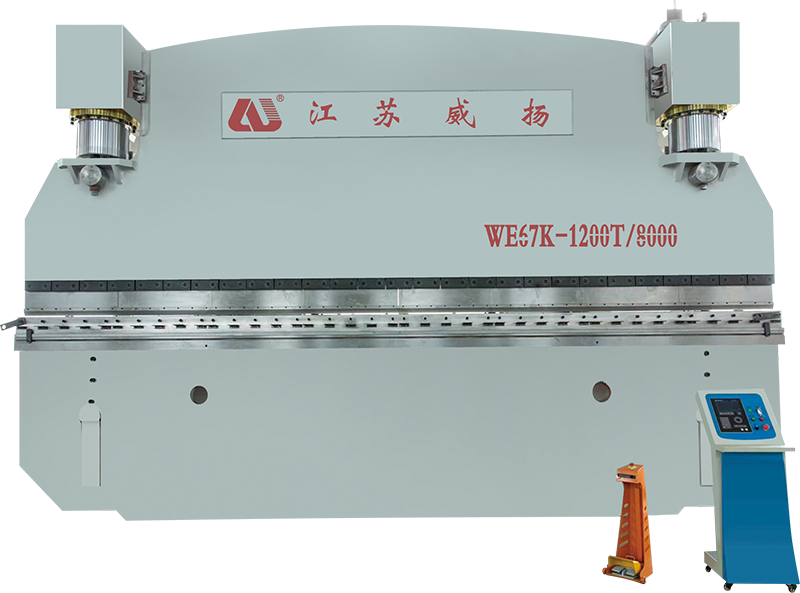
Custom Hydraulic Power CNC Press Brake Machines Manufacturers
